Thermage vs Ulthera vs Morpheus8 — which skin-tightening treatment is right for you? Program Morpheus8, Program Ultherapy PRIME, and Program Thermage FLX are non-surgical skin-lifting technologies that continue to grow in popularity. Although all three programs help stimulate collagen production and restore skin quality in similar ways, they use different energy types, working mechanisms, and depth levels — making each suited to different types of skin concerns.
Many people often ask, “Which machine is best?” But in reality, no single technology is right for everyone, because skin laxity can result from loose skin, collagen loss, facial volume loss, or changes in overall skin quality. Choosing the right program should therefore begin with identifying the underlying cause of the problem, rather than simply picking a machine by name.
Thermage vs Ulthera vs Morpheus8: How Are They Different?
📌 Key Highlights
- Program Morpheus8 uses RF Microneedling technology to help stimulate collagen production while restoring skin quality — suitable for those with concerns such as enlarged pores, acne scars, fine lines, and skin laxity in appropriate candidates.
- Program Ultherapy PRIME uses Focused Ultrasound (MFU-V) energy delivered down to the SMAS layer to help lift and tighten the facial structure — suitable for those with sagging cheeks, an undefined jawline, or drooping brows.
- Program Thermage FLX uses Monopolar Radiofrequency energy to stimulate collagen production in the dermis layer, helping skin appear firmer, tighter, and smoother in suitable candidates.
- When comparing Thermage vs Ulthera vs Morpheus8, all three programs help stimulate collagen production, but they work on different layers of the skin, so they cannot be used interchangeably in every case.
- In some cases, a doctor may plan to use more than one program together to address skin laxity, skin quality, and facial structure, depending on the doctor’s assessment.
- At ProDerma Clinic, a dermatology specialist will assess the underlying cause of the problem and select the program best suited to each individual. Treatment results vary from person to person.
Many people often ask about the differences between the facial-lifting lasers Thermage vs Ulthera vs Morpheus8.
Today, Dr. Ratchayut, a physician at ProDerma Clinic, will share his expertise with us.
All three lasers stand out for facial lifting without the need for surgery.
These are considered the latest technologies, certified by the U.S. Food and Drug Administration for both efficacy and safety.
In the Thermage vs Ulthera vs Morpheus8 lineup, Morpheus8 is the latest technology for non-surgical skin lifting.
It stimulates the reorganization of collagen in the dermis (Dermal Remodeling) and the subdermal fat layer (Subdermal Adipose Remodeling).

Morpheus 8 is the only technology that can shrink the subdermal fat layer, helping aging skin look more youthful. It is also safe for ethnic (darker) skin, as the risk of post-inflammatory hyperpigmentation (PIH) is low.
What Can morpheus8 Help With?
1. Reduces fine lines and wrinkles
2. Treats scars and skin irregularities
3. Improves skin tone
4. Addresses skin laxity on the face and jawline, as well as on the body — such as sagging skin on the upper arms, knees, or abdomen
Which Areas Can morpheus8 Treat?
It can be used all over the face, neck, chest, and abdomen to address stretch marks, loose skin, and sagging on the upper arms and knees.
Treatments can be repeated every 3 to 12 months.
After treatment, light scabbing may occur for about 5–7 days, and sun exposure should be avoided for 2 weeks.
Morpheus 8 Before After
Photos taken 6 months after treatment. Results may vary from person to person.
ThermageFLX
Thermage is a technology that uses monopolar RF radio waves to tighten the fat and dermis layer beneath the skin, the area where collagen resides. This causes the skin to contract and become firmer, reducing cheek fullness and wrinkles, and helping to lift the brows and corners of the mouth.
Who Is Suitable for ThermageFLX Treatment
1. Those with fine lines and wrinkles on the face
2. Crow’s feet
3. Sagging skin
4. Those wanting a firmer, more lifted face
5. Cheek reduction
6. Double chin reduction
Which Areas Can Thermage FLX Treat?
In the Thermage vs Ulthera vs Morpheus8 comparison, Thermage differs from other laser types in that it is the only device that can treat the eyelid area, which requires specific eye shields and specialized tips.
In addition, the laser can also be used all over the face, neck, and body, or any area needing skin tightening.
Treatments can be repeated every 6 to 12 months.
No downtime is required, there are no wounds, and sun exposure is fine afterward.
Photo taken 6 months after Thermage eye treatment
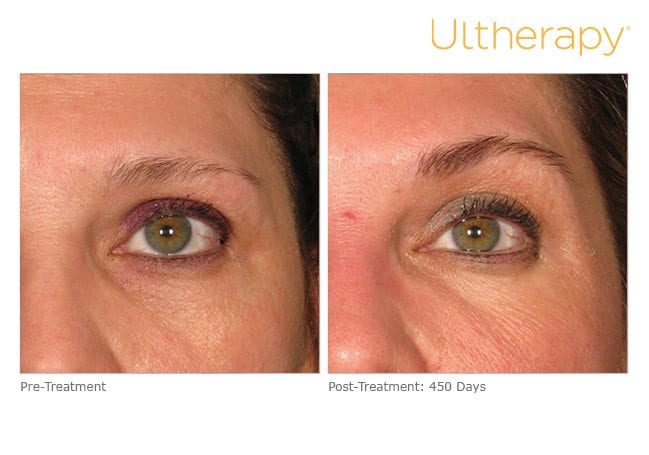
In the Thermage vs Ulthera vs Morpheus8 comparison, Ulthera is a treatment technology that uses highly specific and precise high-frequency sound waves (Micro Focus Ultrasound).
It is the latest innovation in dermatology, used to lift and tighten sagging skin, with a treatment time of approximately 30-45 minutes.
It causes no wounds. After treatment, makeup can be applied as usual with no downtime required. The device delivers precisely targeted ultrasound energy into the skin,
which then converts into small points of heat that penetrate deep beneath the skin, targeting the junction of the upper muscle layer (SMAS), which no other current technology can reach except through surgery.
| Comparison Topic | Ultherapy Microfocused Ultrasound | Thermage FLX Monopolar RF | Morpheus8 Microneedle RF |
|---|---|---|---|
| Technology | Microfocused Ultrasound | Monopolar RF | Microneedle RF |
| Depth from Skin Surface | 1.5–4.5 mm reaching the SMAS layer | Approximately 3 mm fat and collagen layer | 1–4 mm Adjustable by |
| Treatment Purpose | Lifts the face and brows Giving a firmer appearance | Tightens the face Stimulates collagen production | Smooths skin texture Improves acne scars, wrinkles, and pores |
| Who It’s For | Sagging skin Wanting a non-surgical lift | Fuller cheeks or facial fat Wanting a firmer look | Uneven skin texture, acne scars Wrinkles, or enlarged pores |
| Areas Treated | Face, cheeks, brows Neck, and jawline | Eyelids, face Neck, and body | Face, around the eyes Neck, and body |
| Treatment Interval | 6–12 months | 6–12 months | 3–12 months |
| Treatment Duration | Approximately 1–2 hours | Approximately 1–2 hours | Approximately 1–2 hours |
| Downtime | Generally no downtime required | Generally no downtime required | May have slight scabbing for about 1 week Sun exposure should be avoided |
Information courtesy of Dr. Ratchayut Thanapiyachaikul
FAQ
Q1: What is the main difference between Thermage, Ulthera, and Morpheus8?
A: Thermage FLX uses monopolar radiofrequency (RF) to heat the deep dermis and tighten skin from within, without creating any micro-injury. Ulthera (Ultherapy) uses micro-focused ultrasound to reach the SMAS layer — the same layer targeted in a surgical facelift — for a stronger lifting effect. Morpheus8 combines microneedling with RF energy, delivering heat directly into the deeper skin layers to remodel collagen while also improving skin texture and acne scars.
Q2: Which treatment gives the most lifting effect?
A: Ulthera generally provides the most noticeable lift, since micro-focused ultrasound reaches the SMAS layer that supports facial structure — making it a good non-surgical alternative to a facelift, especially for sagging around the jawline and neck. Thermage is better suited for overall skin tightening and smoothing, while Morpheus8 is strongest for improving skin texture, pores, and acne scars alongside mild tightening.
Q3: Is there any downtime after treatment?
A: Thermage and Ulthera typically have little to no downtime — you may return to normal activities immediately, with only mild redness for a few hours. Morpheus8 involves tiny needle punctures, so there may be some redness, swelling, or pinpoint marks for 2–4 days, with makeup usually safe to apply again after about 24–48 hours.
Q4: How many sessions are needed, and how long do results last?
A: Thermage and Ulthera are often done as a single session, with results developing gradually over 2–3 months as new collagen forms, lasting approximately 1–2 years depending on individual skin aging. Morpheus8 usually requires a series of 3 sessions spaced about 4 weeks apart for best results, with effects lasting around 1–2 years as well, and can be maintained with periodic touch-ups.
Q5: Can these treatments be combined, and which one is right for me?
A: Yes — these treatments work on different layers and mechanisms, so many patients combine them for a more complete result, such as pairing Ulthera for lifting with Morpheus8 for texture and pore improvement. The right choice depends on your specific concerns, skin condition, and goals; a dermatologist at ProDerma can assess your skin and recommend the most suitable option or combination for you.
สอบถามข้อมูล หรือส่งภาพ
เพื่อรับคำปรึกษา ฟรี
จากแพทย์เฉพาะทางผิวหนัง
About Us
BOARD CERTIFIED DERMATOLOGIST, AMERICAN BOARD OF DERMATOLOGY IN LASER SURGERY, FELLOWSHIP IN COSMETIC LASER UNIVERSITY OF MIAMI, FELLOW IN DERMATOSURGERY AT RAMATHIBODI HOSPITAL
- 02-2796587
- 02-6198407
- 088-0410888
- 086-5684144
- clinicproderma@gmail.com
- 1019 -1019/1 พหลโยธิน สามเสนใน พญาไท กทม 10400 (ติด BTS สถานีสนามเป้า ทางออกที่ 1 ติดถนนพหลโยธิน ร้านสีขาวทางซ้ายมือ)
- เวลาทำการ : ทุกวันจันทร์ – อาทิตย์ เวลา 11:00 – 20:00 น.
Map
Proderma โพรเดอร์มา คลินิก 1019-1019/1 พหลโยธิน สามเสนใน พญาไท กทม 10400
ฆสพ.สบส.๒๘๙๕/๒๕๖๙